
Food Safety is a hot button issue.
Recently, a handful of academics applied probability theory to a hodgepodge of incomplete data from the Center for Disease Control. Stirring up fear, their conclusion was that the number of cases of foodborne illness annually in the United States is over 9 million illnesses and 2,000 dead a year, most of it unreported. Scary stuff.
Published on the Center for Disease Control website*, their article became the basis for a report from UNITED STATES PUBLIC INTEREST RESEARCH GROUP that was widely distributed in the Media, named “Total Food Recall: Unsafe Foods Putting American Lives at Risk.”
“More needs to be done to protect Americans from the risk of unsafe food.”. Of course, it does, but the point should be, what would be effective. Just doing things because you feel something needs to be done accomplishes nothing, and can make things worse.
The article asserts: “Important rules, standards, and inspections that could significantly improve food safety have been blocked, under-funded, or delayed, allowing the drumbeat of recalls to continue.”.
Is the answer to the world’s problems more inspection, more regulation, more targets and, oddly, more studies, or better process? Inspection is too little too late.
They go on…
“In other words, instead of things getting better, they appear to be getting worse,” “Our food safety practices are falling short.”,
Note the word “appear” before you panic.
I am not an industry defender, or a special interest, but someone who would like to see something done on food safety that makes a real difference: not just a knee-jerk reaction to apparently alarming news. When people reach unreasonable conclusions, it is not to say they are unreasonable people. They are not alone, several articles over the years on food product safety draw unreasoned conclusions, based on incomplete, and imperfectly interpreted data.
The problem is a reliance on the tools of enumerative statistics, rather than analytic or pragmatic. Think big data and weather prediction. It has its limitations. A typical example of enumerative statistics is a political opinion poll; all you do is count and report. Drawing conclusions from enumerative data can be risky because it does not provide much in the way of context.
Analytic statistics is what Nate Silver used to so accurately predict the outcome of the last election, and is all about understanding data in context.
Pragmatic statistics is what is used in process improvement, taking the theories generated by analytical statistics, and testing them, where opinion rubs up against reality.
Statistical data, studied in the abstract, is less science than abstract math. Logical connections can be found in the abstract that simply do not exist in the real world. When looking at data presented in tables, in muddled sequence, arranged without real affinity, mixing areas of opportunity (a fancy way of saying comparing apples to oranges), it is easy to find things that don’t exist.
No sickness is the right amount. But, before we jump whole hog into a number of new regulations and standards, doesn’t it make sense that we should take a look at what is really going on first? Find the real cause, the root cause, the one that will truly make things better?
The article continues, with a seemingly reasonable statement on Food Safety…!
“The prominence of dairy in the study model reflects a relatively high number of reported outbreaks associated with raw milk compared with the quantity of raw milk consumed and issues related to Campylobacter spp infection; these factors likely resulted in an overestimation of illnesses attributed to dairy.”
While true, it is hardly the only, nor the most important influence on the “overestimation” of illnesses attributed to dairy. As you will see, far more than pasteurized or unpasteurized; whether the food was commercially produced or not is key.*** Is it fair to lump the results from non-commercial and commercial sources together?
Measures of Comparison
“An estimated 629 (43 percent) deaths each year were attributed to land animals, 363 to plant, and 94 to aquatic commodities… followed by dairy (10 percent) etc.”.
Are they saying that every year 62.9 people die from dairy, or are they saying 10 percent of all illnesses? A cow is a land animal after all, as are goats, sheep, yaks, and buffalo. Or am I supposed to figure out what 639 is 42% of and then multiply by 10% for myself?
Averages presented as if they are real things is a serious problem, especially when there are wide swings in variation from point to point. If you average your pay and Bill Gates’, does that give you any idea about his salary or yours? Hardly! Averages are comparisons, not real things.
The Perils of Percents!
Percents are meaningless unless you know the base number, and worse than meaningless if they are based on different numbers. As an example, a dollar compared to 10 dollars is 10 percent, to 100 dollars, only 1 percent, but it is still a dollar! How many deaths from dairy were there? The actual database is not clear because no one knows. The reporting system does not function well enough to know, leaving the door open to sensationalism.
And then comes this nonsense, parading as science:
“One surprising fact consumers should take away from the CDC study of foodborne illnesses between 1998 and 2008 is that dairy products, including milk, cheese, and ice cream, are big contributors to foodborne illness,”!
“Dairy products ranked as the leading cause of hospitalizations linked to foodborne illness; second to leafy greens in the numbers of illnesses; and second to poultry in the numbers of deaths,”.
Attributed to Caroline Smith DeWaal, food safety director at the Center for Science in the Public Interest (CSPI).
Without an understanding of the industry itself, someone from an interest group can end up making what sounds like food safety sense, but isn’t. Their desire for hot button issues to gain media attention, and lack of training in how to interpret data correctly, leads to conclusions that will make things worse, not better. It takes the focus away from what could genuinely help secure the safety of our food supply. The following, from the article, sounds dramatic:
“Therefore, the incidence of reported outbreaks involving non-pasteurized dairy products was ≈150× greater, per unit of dairy product consumed, than the incidence involving pasteurized products. If, as it is probably more likely, <1% of dairy products are consumed non-pasteurized, then the relative risk per unit of non-pasteurized dairy product consumed would be even higher.”
Using other people’s interpretations of data, you get 150x more nonsense. How do they define incidence: by outbreak? Number of people sickened? What is less than one percent? Is it .9 or .5 or .1 percent? With the population of the US hovering around 314 million people, that represents a spread of more than 2,800,000 people, out of which, how many consume dairy products?
It may seem like it, but I am not nitpicking here: Major changes are being called for, up to and including rules that could put an end to what real people depend on for their livelihood: aged raw milk cheese; based on nothing more than a song and a throw of the dice
Shooting from the hip misses the target, and can kill innocent bystanders.
- Does the data they use compare apples to oranges?
- Do they attempt to separate the signals from the noise?
- Are their calculations on the assumption of a normal distribution***, something that rarely exists in complex, messy systems like the food chain?
- Did they make no attempt to verify?
Is a knee-jerk reaction to less than stellar analysis based on imperfectly collected, organized, and presented data enough to put an end to one of the last bastions for small family farmers; while sending raw fluid milk production underground, where how it is processed will be improved.
The facts, seen in context, do not bear out these conclusions. I know because I went back to the source, the CDC foodborne outbreak database. I will share what I found with you.
The data does not support the conclusions
I downloaded the actual data, from https://www.cdc.gov/foodsafety/outbreaks/index.html. The same source they used, and applied the skills I have been lucky enough to learn from the likes of Donald Wheeler, Rafael Aguayo, and others. The results point to very different conclusions than those posted on the CDC website, with some promising potential solutions, if we keep in mind that they must be tested first.
I was looking for pragmatic ways to have a real impact on lowering the incidence of foodborne illness in dairy products. To my surprise, I uncovered more, some insight into commonly shared beliefs surrounding the relative safety of dairy products, both pasteurized and raw.
To review, I downloaded all reported food outbreaks from 1998 to 2010. I removed all with unconfirmed causes, or where the food involved was unclear, (which eliminated about 60% of the data.) I kept any that had “suspected” causes, as having been involved in a few incidents myself, I know how hard it is to fix the exact cause, and what suspected means: a guess.
Furthermore, I removed all that came from bacteria that are not associated with Dairy Foods, and that can only contaminate after the product leaves the processing plant, like staph. The poor quality of the data would make it difficult or impossible to determine if any single incident is a signal or noise.
The results point to very different conclusions than those posted on the CDC website, with some promising potential solutions, if we keep in mind that they must be tested first.
1998-2010 Confirmed or Suspected Dairy Related Food Outbreaks
| Non-Commercial | Outbreaks | Ill | Hospital | Dead |
| Raw | 129 | 2262 | 224 | 3 |
| Unspecified | 41 | 598 | 116 | 0 |
| Homemade | 20 | 154 | 44 | 0 |
| Pasteurized | 10 | 153 | 35 | 4 |
| TOTALS | 200 | 3167 | 423 | 7 |
| Commercial | Outbreaks | Ill | Hospital | Dead |
| Unspecified | 30 | 1184 | 72 | 0 |
| Raw | 2 | 244 | 12 | 0 |
| Pasteurized | 5 | 243 | 12 | 1 |
| TOTALS | 37 | 1671 | 96 | 1 |
Tables of data can be misleading; they don’t provide enough context. It would be easy to assume from this that there is a huge difference in risk between pasteurized and raw milk, one of the beliefs commonly shared, but when seen in the context of commercial production, looks very different. What you are looking at includes,
Non-Commercial product from private homes, farmhouses, church events, and picnics as well as commercially produced.
The “homemade” in fact is homemade ice cream. The available data is not clear if raw milk outbreaks came from farmers drinking their own milk, or from those who buy raw milk locally from the farmer. More research would need to be done.
The numbers for commercial products tell a different story, don’t they? Is it possible that the raw milk controversy consuming the dairy industry and some legislatures may be a classic red herring, taking attention and resources away from what could really make a difference?
Rather than trying to distance itself from raw milk products, the industry would be better served trying to ensure the industry as a whole is not compared to non-commercial products. It is fundamentally unfair to include commercially produced with non-commercial product in the same analysis, and then draw conclusions affecting both.
The single death reported from a confirmed commercial product over those 12 years occurred in a pasteurized cheese bought in a supermarket in Oregon in 2006, and was caused by listeria. Even among non-commercial deaths, most came from “bath-tub” producers of fresh Mexican style cheese, both raw and pasteurized. I am not attempting to minimize the tragedy of anyone dying, nor the inherent risks in raw milk, but trying to understand how to deal with what really happened and is likely to happen again. To prevent it, we need to find the real causes and stop blaming the easy targets.
It is fundamentally unfair to include commercially produced with non-commercial product in the same analysis, and then draw conclusions affecting both.
The single death reported from a confirmed commercial product over those 12 years occurred in a pasteurized cheese bought in a supermarket in Oregon in 2006, and was caused by listeria. Even among non-commercial deaths, most came from “bath-tub” producers of fresh Mexican style cheese, both raw and pasteurized.
I am not trying to minimize the tragedy of anyone dying, nor the inherent risks in raw milk, but trying to understand how to deal with what really happened and is likely to happen again. To prevent it, we need to find the real causes and stop blaming the easy targets.
Commercial Incidents
The largest number of outbreaks among commercially produced and sold products took place in Restaurants, and the largest number of illnesses per outbreak in Schools and Camps. This makes sense since the number of people served the same food in camp or school is greater.
| LOCATION | Outbreaks | Ill | Hospital | Dead |
| Restaurant | 19 | 351 | 24 | 0 |
| School | 9 | 904 | 42 | 0 |
| Camp | 3 | 217 | 7 | 0 |
| Grocery Store | 2 | 6 | 4 | 1 |
| Hospital | 1 | 6 | 1 | 0 |
| Nursing Home | 1 | 21 | 4 | 0 |
| Office Setting | 1 | 31 | 4 | 0 |
| Prison | 1 | 135 | 10 | 0 |
| Raw | 2 | 244 | 12 | 0 |
| Pasteurized | 5 | 243 | 12 | 1 |
| TOTALS | 37 | 1671 | 96 | 1 |
Two-thirds of the 904 illnesses in the schools took place in only five incidents from 2001 to 2005. Three of those were caused by salmonella, with one from pasteurized 2 percent milk, and two others from foods made with cheese, which, based on experience, raises the question of food handling, rather than the innate integrity coming from the factory. In fact, except for the two incidents from grocery stores, most of the other incidents involved post process food handling.
What Matters
A Pareto chart is a useful tool that helps us discern the relative few that really matter
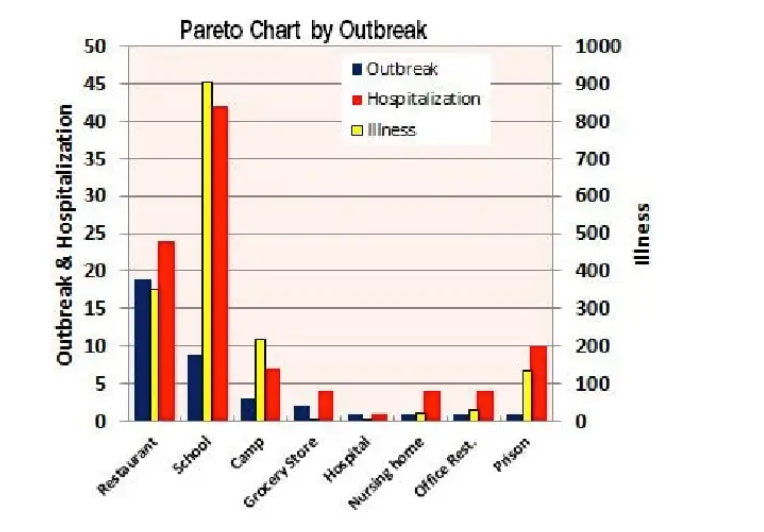
In the chart above, we can see the data organized by most outbreaks to least. This tool helps us figure out where to begin to look to improve the right processes, the ones that will make the most difference.
Focusing on Restaurants and Schools would have a giant impact, based on the data we have. Looking at it from the point of view of illnesses caused, the first place to find a solution would be in schools, the second restaurants. Schools would be easier as the number of illnesses per outbreak tends to be greater.
If solutions can be found for the above, they would eliminate over half the illnesses reported for Dairy Products. To avoid making the same mistakes, it is essential to note that this applies only to the incidents collected. The data is incomplete and insufficient to draw overall conclusions, requiring verification before acting, which would be relatively easy to do. If the arrow clearly points to schools and restaurants, where the contamination is post-processing, what will more regulations and inspections for the manufacturer do to help?
| GERM | Outbreaks | Ill | Hospital | Dead |
| Salmonella | 84 | 2497 | 285 | 1 |
| Campylobacter | 119 | 1592 | 80 | 2 |
| E-Coli | 26 | 826 | 132 | 0 |
| Listeria | 7 | 68 | 43 | 6 |
| Brucella | 5 | 18 | 7 | 0 |
| Other | 3 | 14 | 1 | 0 |
| TOTALS | 244 | 5015 | 548 | 9 |
This table includes both commercial and non-commercial sources in the data. While the most outbreaks were caused by Campylobacter, the most illnesses were caused by Salmonella, by a large margin. Putting Salmonella aside for a moment, one part of the story in the data becomes clear when you consider the link between Campylobacter and Raw Milk: only a tiny number of outbreaks from this germ are linked to anything else.
This is good news. If a way to mitigate campylobacter in raw milk can be found, and processing improved, a huge number of cases could be eliminated.
With most illnesses coming from Enteric Salmonella, a close study would have to be done where the incidents happen to find out how the contamination takes place. It will most certainly involve food handling, as most of the incidents involve secondary processing, meaning after the product leaves the manufacturer, of pasteurized dairy products. But some reasonable assumptions can be made, based on an understanding of statistical thinking, and the intensity of some things, as you will see, are clearly signals, based on knowledge of food production, handling, and distribution.
A More Reasonable Approach
I will summarize now what I found in my research, and make what, I think, are reasonable and effective suggestions on which to focus resources to find real solutions.
A handful of epidemiologists applied probability theory to a hodgepodge of data to come up with the number of cases of foodborne illness annually in the United States. The number they come up with is over 9 million illnesses and 2,000 dead a year. They provide no empirical evidence to back this rather drastic assertion. By empirical, I mean verifiable by observation or experience rather than just theory or pure logic.
Are we supposed to accept it at face value, and make major changes in public policy? Sadly, that is what happens in society, and in businesses, all the time.
Mental Gymnastics are Not the Same as Reality
Mental gymnastics done to try to help decide where to apply limited resources to proactively confront the problems the US “may” face in the future seem laudable, but the road to ruin is paved with good intentions. The solutions the analysts come up with based on untested, misapplied theories include more inspection, placing a greater financial burden on industry to maintain arbitrary standards that most likely will not make a difference. Ill wrought solutions take eyes off what really makes a difference, leading to calls, within some government agencies, for banning whole classes of products, and sectors of the food and dairy industries.
But without understanding the real causes of the unwanted results, we risk a considerable expenditure of already limited resources to accomplish little more than the destruction of one of the last great hopes for the survival of American Family Farming: aged raw milk cheese, among other products. It doesn’t have to be this way. Valuable things can be gained from looking at data analytically, even when incomplete, then testing pragmatically. Rather than make grand guesses, find the meaning buried within what reliable data there is. The probability calculations the study authors used were based on counts of what has happened, and guesses, with little to no context provided. To understand, to find concrete actions that can be taken to improve a situation, context needs to be provided. With context, the meaning buried in the data can be found. Some of what has happened in the past will be useful for prediction, and some just plain wacky. You first have to separate the signals from the noise. Otherwise, all we end up doing is making logical connections that have nothing to do with reality: stuff and nonsense.
Pragmatism
Reality is still the only place to get a good steak.**
Understanding generated from analysis can build a theory, but that theory must accurately predict changes in the real world and be verified. Though, solutions being considered as public policy are logical.
- Ban raw fluid milk,
- and some raw milk products
- increase the time of aging for aged raw milk cheese from 60 to 90 days before it can be sold,
But, will they solve the problem? Not based on the data. The data indicates the need to:
- Separate non-commercial from commercial,
- Take a closer look at food handling after manufacture,
- Particularly in restaurants, schools, and camps,
- And the dominance of campylobacter and salmonella
as where to look to find solutions to the vast majority of the things that actually happened in what reliable data we were able to extract.
Neither of these have been a problem with aged raw milk cheese, except where the evidence points to post manufacturer handling. Do we start a war on raw milk, or do we dig deeper, and solve the real problem, through understanding and better process?
The same or similar issues happen with post manufacturer food handling with pasteurized milk, and in fact, the only fully confirmed death from a commercially approved dairy product was from listeria in a pasteurized cheese in this data set. Vague threats of potential under-reporting miss the point.
What matters is what “IS”, not what “could” be, if you want to solve a problem.
*http://wwwnc.cdc.gov/eid/article/17/1/pdfs/p1-1101.pdf
** Woody Allen
***www.food.gov.uk-multimedia-pdfs-campylobacterstrategy.pdf
Increasing the burden on producers based on dicey probability calculations not what really happens would devastate family farms
Banning the sale of raw milk to those who have already chosen an alternative lifestyle, might simply force the industry underground, where illness would occur, but go undetected. Unhygienic conditions that allow pathogens to develop, may one day produce resistant strains like 0157. The only solution is continually improving processes.
If the Food Industry, in these examples, the Dairy Industry wants to do something positive, something with vision, rather than merely point the finger at raw milk, or loopy tree huggers, it should invest in and lobby for real resources to develop a rapid test for Campylobacter, and an industry wide effort to continually improve milking parlors, holding tanks, and feed cutting practices.
While some of the milk used in commercial operations is listed as “unspecified,” it is reasonable to assume that the product was pasteurized during manufacture, given the type of products listed (see the database link), and therefore, was contaminated after leaving the processing plant.
The industry should invest in, and support educating consumers about better food handling practices, and work with their foodservice customers to ensure safer food through better handling after manufacture, as many of the outbreaks reported involve post-plant secondary processing.
If I could, I would require the study of analytic, pragmatic statistics in Government, Private Business, and Business Schools, so we could start to make a real difference in how our world is really run. We may not get definitive answers, but we get a good hint of where to really look.
*http://wwwnc.cdc.gov/eid/article/17/1/pdfs/p1-1101.pdf
** Woody Allen
***www.food.gov.uk-multimedia-pdfs-campylobacterstrategy.pdf
Your comments on the FDA vs. USDA vs…. etc. are very apt. The entire structure of the food safety system is wrong for Quality and process improvement. Balkanized. Filled with misunderstanding and fear.
I am beginning a paper for StratML.gov on how the new markup language for government agencies to define their missions, could be adapted to use in public/private initiatives as a way of breaking down the walls of misunderstanding and will post it here when done.
some shooting from the hip without due diligence:
There has to be understanding of how all the pieces fit first, then some kind of general agreement on what is trying to be accomplished.
The best model I have seen for effectiveness in public private initiatives has been the agricultural service working out of the land grant colleges in the US. Not perfect, but because it was adhoc, created during the works progress administration era of the depression, at grassroots level, much freedom was left to the individual agent, linked to farmers directly, and not wonks in offices dictating what should or should not be done: it is a highly adaptable, vibrant, and essential service accomplishing amazing things in the background. Something similar perhaps could help in creating a sense of joint involvement in food safety.
And we need to start with,
Is the increase an increase in reporting or an increase in actual outbreaks?
Where exactly is it increasing if it is?
What kinds of foods, what kinds of outlets?
Where in the process?
Which bacteria?
And try to find the connections, the context. We can’t do that without trust between everyone and good data.
So, how can we make food safety visionary, so the cook who is preparing the food to the farmer in the fields to the scientist in his lab to the bureaucrat in a government office to the consumer, who may have to pay more to ensure safe food, are all working together towards the same thing? The answer to the question, what are we trying to accomplish, on the tip of the tongue of everyone in the food chain: If we want to get serious about finding a solution. Putting the BIG brain to work.
And be open to the fact that the solution could have to do with logistics, how far food travels, or even that there is no solution there is only mitigation. We all have points of view, but are like the wiremen and the elephant, but we obviously don’t yet have the answer, and the only way to get that answer is in looking at the how and testing. This much I’ll say, the food safety audit system is good for the auditing company, and ensure great paperwork, but in practice, though there are some improvements, the us against them mentality leads to changes in the paperwork more than understanding and real change in the handling of the food. It is the wrong approach: economically wasteful, not guaranteeing safe food as you mentioned, and naive psychologically: but very lucrative for some.
If you ask the farmer what food safety is, he will tell you a department in state government that is a pain in the tucus, and costs him money.
The restauranteur: something to be feared.
The cook: something that always gets them in trouble
The inspector: something the people who they inspect are always cheating on.
The scientist, I don’t know because I am not one…. etc.
all the way down to the consumer who wants it FREE, PERFECT and NOW.
WE need to get representatives of everyone down to the table to create the full vision, model what we think is going on, go to where the action is to ensure that is what is going on, without the threat of ill affect if there is not compliance. No improvement can take place in an atmosphere of fear.
Until then we are trapped in a labyrinth, and at the whim of chance.
Very good observations Lynton thank you. Worth pondering why. Of course, haven’t the slightest but would be a problem I would love to dig into. I wonder if authorities knowing what needs to be done is enough. Even providing guidelines. Quality needs to be built into the process. Currently, there is not a clear vision in the food service industry, and the relationship remains antagonistic, at least in the US, and the companies and individuals are dealing with a very complex, adaptive system filled with the most complex of all, people. There are economic pressures as well, and the ongoing attitude that you fix things up for the inspection or audit… better known as CYA quality. I had the head of quality for a major distributor tell me that they were only going SQF, the US version of the Global Food Safety Initiative, because their insurance told them to. CYA. (Cover your ….., for the uninitiated.
To find the answer we would need that joined-up thinking you mention, and some of the tools from soft systems: those ugly concept maps, understanding the entire system, not just the biological, and only then, perhaps, find where to start looking for things that could really make a difference.
Cont…
Yet, year on year the cases still increase even in the UK. What is it then about the food service situation that despite the knowledge we have that such little success has been had?
I wonder sometimes in the US whether the agencies charged with food safety actually speak together but it is sure that the distiction of responsibilities between food in interstate commerce and that only within a State is one factor that hampers ‘joined-up’ thinking. For instance in the USDA ‘master plan’ there is no mention whatsoever of the FDA FSMA document ( Food Safety Modernisation Act).
Such interagency difference makes for unhelpful competition? Certainly pointing the finger at raw dairy or raw meat is a neat way to point the finger at USDA
Hi
What you say is of course true. May I say though that a lot of what you mention should be done has already been done. Back in the seventies and before at the Public Health Laboratory Service in the Uk. Food service situations either in restaurants or institutions or at large scale gatherings, along with home-cooked foods (particularly at barbecue seaon) were identified as those most important places where foodborne disease occurs.
They also analysed closely the practices in outbreaks that contributed to outbreaks. I won’t write the list but it has formed the basis of all education and inspection carried out since. The CDC know this very well as do FDA, USDA and no doubt State and City Public health
Would you rather have the following approach?
“Estimates of Food-borne Illness in Canada
The Public Health Agency of Canada estimates that each year roughly one in eight Canadians (or four million people) get sick due to domestically acquired food-borne diseases. This estimate provides the most accurate picture yet of which food-borne bacteria, viruses, and parasites (“pathogens”) are causing the most illnesses in Canada, as well as estimating the number of food-borne illnesses without a known cause.
In general, Canada has a very safe food supply; however, this estimate shows that there is still work to be done to prevent and control food-borne illness in Canada, to focus efforts on pathogens which cause the greatest burden and to better understand food-borne illness without a known cause.”
see http://www.phac-aspc.gc.ca/efwd-emoha/efbi-emoa-eng.php
As a Canadian food microbiologist I have long disliked much about what we say about foodborne disease – it is often scientists spouting their not so science based opinion. One example is the inclusion of lost productivity due to foodborne disease. Since I lived off the avails of bad food not good food I felt working on an outbreak was productive work. In fact, often the loss in productivity is smaller that the payroll and wealth generated from work that would not exist if there was no outbreak. On the other hand, I give a talk entitled:
LET’S GET REAL ABOUT FOOD SAFETY! NO MORE BULLSHIT/TRUTHINESS PLEASE!
THE FOOD SUPPLY HAS NOT BEEN SAFE SINCE EVE AND ADAM ATE THE APPLE!
and finally let me quote Living with Risk by The British Medical Association “Nothing in life is safe!”
Bill, thank you very much for your comments. It is very frustrating when so much time and effort is spent on something that should really be about mitigation of real risk, not zero defect thinking. As you mentioned, food is alive, and moving it over distance is inherently risky. By better analysis we can focus in on things that can make a real difference, but never fully remove all risk. What is needed is real understanding and a cooperative effort on all parts of the food industry, not legal grandstanding, and inspection after the fact. By the time inspection finds something it is too late. The solution is more complex, less newsworthy but more effective: better process, and better understanding, don’t you think?
Oh, and thanks for the link. They are again using probability theory, from first glance. Great for describing a population of data, not so great for predicting in a less that stable complex world like food distribution. What does it profit them to guess at a number when what matters is to go back and look at the process from the ground up, literally, and work on improving it. (In statistical terms, there is most likely not a normal distribution, and probability theory doesn’t work for prediction when the data is not normally distributed. Food is not a closed system, there is a lot of complexity in it. Dr. Deming, who is my main influence, would say, quality is everyone’s job, and you can’t inspect it in. Only by better process, building quality in from the get go, can you make real progress. Inspection after the fact doesn’t work. And for me, these kinds of studies make money for the academics who do them, but take our eyes off of the ball.